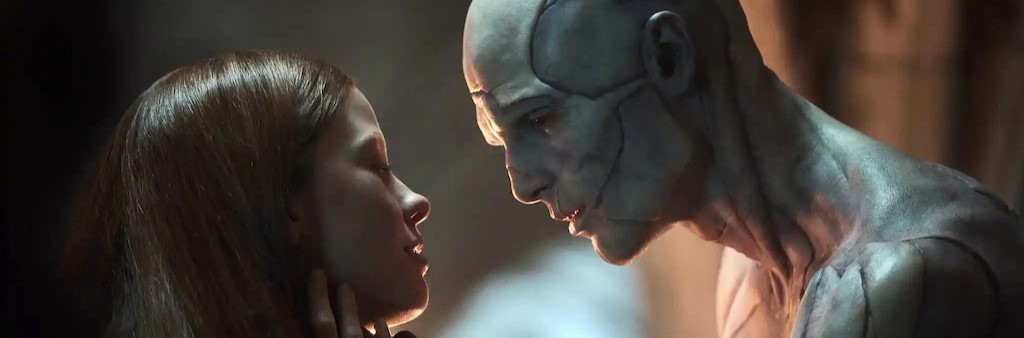
Monster narratives and monsters in stories have been popular for as long as I can remember (albeit 30 years isn’t very long), and they will continue being more relevant in 2026 because of the social climate that is fostering. As exhibited in my other posts, I love monster narratives in movies, books, and video games, whether they are literal monsters like Frankenstein’s creature, or metaphorical monsters like the societal perception of elderly and aging women.

Guillermo Del Toro. (2025). Frankenstein. [Film]. Double Dare You, Demilo Films, & Bluegrass 7.
In my Frankenstein post, I talk about how Mary Shelley uses Frankenstein’s creature as a way to showcase the Other in a “socially acceptable” way. Dr. Frankenstein creating a creature is shocking, yes, but highlighting what it feels like to be a social outcast can be easier when using an entity that is not exactly human.

I briefly mention how Frankenstein can be perceived as a feminist novel, and I agree with this reading. Women, especially in Shelley’s age, have been socially outcasted and misunderstood even now (I won’t direct you to the amalgamation of poorly written women in media). Instead of Shelley writing a narrative that says “look at what it feels like to be a woman in the 1800s,” she uses a creature who is both human and non-human simultaneously. Exploring concepts that aren’t easily digestible when spoken about directly can be made somewhat easier when using metaphors.

**juke joint not shown**
Ryan Coogler. (2025). Sinners. [Film]. Froximity Media.
Monster narratives have also been gaining a lot of traction in recent years whether it’s the TV series adaptation of Naughty Dog’s 2013 and 2020 video game series The Last of Us, Ryan Coogler‘s 2025 film Sinners, or Josh Malerman’s 2024 novel Incidents Around the House. In my post about Slender Man and Siren Head, I talk about how and why certain themes and concepts become popular at specific times in human history. I think this trend of dismantling the human body to highlight complex concepts is something that is gaining more popularity for a reason.

Perhaps, analyzing and actively interacting with these monster narratives is more important in 2026 than ever because of the ever-growing governmental censorship. Book banning and censoring of certain communities is growing in popularity in many countries – Canada included. Having the ability to analyze and read between the lines of monster narratives gives the reader, viewer, player, the strength to learn about the world we live in. Below is a great 5 minute video about the importance of media literacy, and why it is the everyday person’s super power.
Seeing the connection between the monster transformations in Hayao Miyazaki’s Howl’s Moving Castle, which I explore here, isn’t just a cool party trick. Media literacy helps people understand the world around them and helps them formulate ideas about their communities. Understanding that a monster isn’t only something that scares us in the dark, but can be almost anything, gives us strength.
To give a small sneak peek at my next blog post, the 2022 animated Netflix series, Cyberpunk: Edgerunners is riddled with humans with technological body modifications, some that look quite monstrous. Though I would consider some of these people as monsters, the most ominous monster of them all is the city the show takes place in, Night City, and capitalism.

Hiroyuki Imaishi. (2022). Cyberpunk: Edgerunners [TV Series]. Trigger & CD Projekt.
I will be going deeper about what this means, but taking the series at face value removes the ability to understand how capitalism and certain city dynamics steal lives and youth away from people. Without media literacy and understanding what makes a monster a monster, the narrative changes completely.
Governmental censorship specifically involving fiction (movies, books, and television) will continue being a problem, and storytellers and writers will continue telling stories that need to be told. It’s our job as readers, watchers, players, and community members in general to have the ability to show up and understand those stories in whatever way they will be given to us.
Next time you see a monster on screen, think about what else the storyteller wants you to think about.
Happy 2026, and I can’t wait to bring more posts about my favourite monsters and narratives. If you missed reading about specific monsters this week, check out one of my other posts, like this one about Little Nightmares II!
Thank you for reading, and remember to stay curious.
See you later,
Lysh
Featured Image Credit: Guillermo Del Toro. (2025). Frankenstein. [Film]. Double Dare You, Demilo Films, & Bluegrass 7.
Leave a Reply