
If you read my previous post and thought the Thin Man has a striking resemblance to the internet phenomenon Slender Man, you thought the same as me (if you didn’t, I’ll catch you up to speed). Slender Man has been a monster I’ve known since early high school and is still relevant in online spaces to this day.
Thinking about Slender Man’s reach and relevance has made me wonder at what point do internet phenomena transcend the space of “internet culture” and become modern culture? If a phenomenon does successfully transcend this label, what does it take to become an urban legend? And lastly, did the shift away from oral storytelling affect how we see modern monsters?

Brittanica describes an urban legend as “a story about an unusual or humorous event that many people believe to be true but is not true,” and continues to explain that “urban legends typically combine secondhand narratives, such as those heard from “a friend of a friend,” with contemporary setting and familiar everyday objects.” These explanations would make it seem like internet monsters like Slender Man could be categorized under the title of urban legend, but the secondhand nature of the storytelling is what makes things sticky.

When it comes to Slender Man and other internet monsters like Siren Head, we know exactly who made them and where they became popular. Slender Man’s first appearance was in 2009 on a Something Awful forum. Eric Knudsen entered a photoshop contest on the website which challenged users to “create paranormal images”. Accompanying his two photoshop images were small blurbs that acted as mysterious narratives which gave the anomaly life. From here, Slender Man gained traction and has been adapted into more internet stories as well as offline fiction like video games, novels, movies, and television shows.
Siren Head is a newer online monster that has gained notoriety since its conception in 2018; Trevor Henderson posted the first image of Siren Head on his Instagram and X (then Twitter) accounts in August that year. Before this, Henderson already had a hefty following, but Siren Head blew his reach out of proportion. Within the next two years, Siren Head became extremely recognizable online, with new legends and narratives growing about the monster, much like Slender Man’s experience.
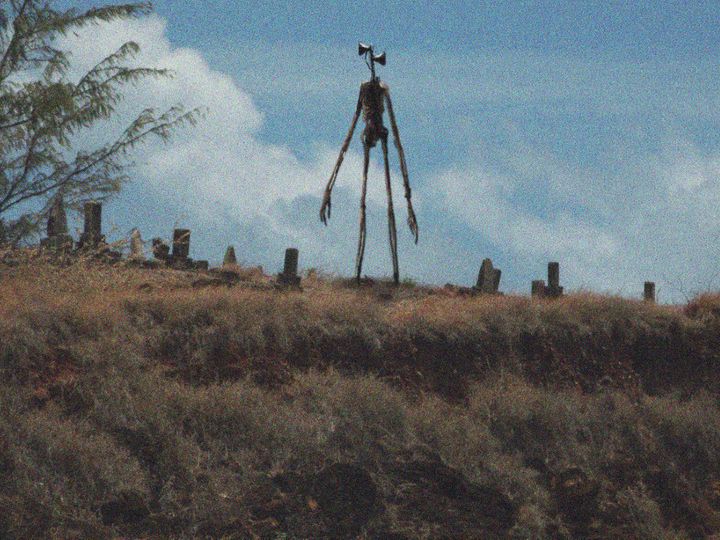
Since we know both monsters’ origins, it begs the question, can a creature or event still be an urban legend if we know the origin? Though both monsters were created with an essence of “found footage”, which resembles the secondhand storytelling mentioned previously, knowing the author of these monsters erases the mystery. Medieval historian Dr. Juliette Woods says yes, these monsters would still be considered urban legends. Internet legends and urban legends can be fluid within each other. In relation to folklore, she also explains that part of a creature’s cultural relevance is its ability to develop past its origin which Slender Man and Siren Head both do.
Interestingly enough, I have seen multiple members in different Slender Man related online communities say that they don’t consider the monster to be anything other than an internet or Creepypasta monster. Though, I wonder if this reaction is due to communities wanting to gatekeep their icons.
Internet communities sometimes fail to acknowledge the cultural relevance of these monsters. For instance, Siren Head being created and gaining popularity during 2018 – 2020 makes me wonder what was happening socially that made a monster that signals grand levels of despair become so popular… Yes, cryptids, found footage, and liminal spaces did gain popularity during that time, but why was Siren Head the creature that earned notoriety?
The COVID-19 pandemic, as well as the general destruction worldwide, would have a hand in the monster’s growth. For me, Siren Head feels a little like an amalgamation of the emotions stirring at that time. We were all locked in our homes and powerless to the flow of life; what could be more terrifying than a monster that not only signals impending terror, but also brings it? Siren Head is the monster you can’t ignore.
With me taking on the role of “cultural analyst” as an amateur, the reason for Slender Man’s exponential cultural growth is harder to pinpoint. Part of me thinks that Slender Man’s origin story fits well within the “stranger danger” warnings and stories of the early 2000s. It’s not enough for me to say its popularity is solely due to the found footage and mysterious nature of its origins.
I believe ideas and concepts gain popularity because of the cultural subconscious; certain genres, movies, and general trains of thought become popular at specific times because of cultural reasons. In this way, Siren Head’s popularity makes sense to me, but for Slender Man, I don’t think I know enough to say for sure. During my research, I found a lot of articles talking about how Slender Man became popular, but none asking why it became popular.
With the rise of community gatekeeping and having more surface-level interactions with media and creatures, I don’t think the shift away from oral storytelling is the only thing that has affected how we perceive modern monsters. Regardless, I’d like to believe that, due to the many iterations of both Slender Man and Siren Head, 100 years from now their origins will be lost and they will be spoken about like urban legends and not just internet phenomena; I think they deserve that title. I’d like real cultural analysts to explain why they were relevant to today’s culture better than I ever could.
Though I don’t talk about them in this post, I’ve love to hear what your favourite cryptid, urban legend, or folklore is in the comments! It doesn’t have to be a monster if you don’t have a favourite one.
Thank you for reading, and remember to stay curious!
See you later,
Lysh
Featured Image Credit: Original Slender Man photo by Eric Knudsen for Something Awful (2009)


 Monster Chasing with Lysh
Leave a comment